.png)
How Technology Optimizes Pickup and Drop Logistics
Gubbins | 2026-02-23In a fast-moving city like Delhi, time is everything. Whether it is sending important documents, delivering a birthday cake, or getting groceries at the last minute, people expect speed and reliability. This is where a professional pickup and drop-off service becomes essential.
Technology has completely changed how a pickup and drop service works today. From real-time tracking to smart route planning, digital tools make deliveries faster, safer, and more accurate. Businesses and customers both benefit from these improvements.
Let us understand how technology is optimizing the pickup and drop service industry, especially in a busy region like Delhi NCR.
The Rise of Smart Logistics in Delhi
Delhi is one of the busiest cities in India. Traffic congestion, long distances, and peak-hour rush make logistics challenging. Earlier, delivery operations were managed manually. Calls were taken over the phone, drivers were assigned without tracking systems, and updates were often delayed.
Today, a modern Pickup and drop service uses advanced software, GPS tracking, and mobile applications to manage operations efficiently. Technology reduces confusion, avoids delays, and ensures smooth coordination between customers, drivers, and support teams.
A reliable delivery service in Delhi now depends more on smart systems than on manual coordination.
Real-Time Tracking Improves Transparency
One of the biggest advantages of technology in pickup and drop-off service operations is live tracking.
Customers no longer need to call multiple times to ask about delivery status. With GPS integration:
- Customers can track their parcel in real time.
- Businesses can monitor driver movement.
- The estimated delivery time is shown clearly.
- Delays are identified immediately.
For example, if someone orders online cake delivery in Delhi, they want to know exactly when the cake will arrive. Real-time tracking ensures transparency and builds trust.
Similarly, cake delivery in Delhi during festivals or special occasions requires precise timing. Technology helps ensure that cakes reach customers fresh and on time.
Smart Route Optimization Saves Time
Delhi traffic is unpredictable. Without proper route planning, deliveries can get delayed.
Modern pickup and drop service platforms use AI-based route optimization tools. These tools:
- Analyze traffic conditions.
- Suggest the fastest routes.
- Avoid blocked roads.
- Reduce fuel consumption.
For a delivery service in Delhi, route optimization can reduce delivery time by up to 30 percent. This means faster service and happier customers.
When handling time-sensitive orders such as online cake delivery in Delhi or urgent document drops, optimized routing becomes critical.
Seamless App-Based Booking
Customers today prefer booking services through mobile apps instead of making phone calls. A technology-driven pickup and drop service offers easy booking through apps and websites.
With just a few clicks, customers can:
- Enter pickup and drop locations.
- Choose delivery type.
- View pricing instantly.
- Make online payments.
- Schedule same-day or express delivery.
This is similar to how people use an instant grocery delivery app for daily essentials. Convenience is key. In fact, many customers compare logistics services to the best grocery delivery app experience. If booking is smooth and fast, they are more likely to return.
Automated Order Management
Managing multiple deliveries manually can create confusion. Technology solves this problem with centralized dashboards.
A professional pickup and drop service uses order management systems that:
- Assign drivers automatically.
- Send instant notifications to customers.
- Generate digital invoices.
- Maintain delivery history records.
This system is especially useful for businesses that require bulk dispatch. For example, bakeries offering cake delivery in Delhi can integrate their system with a Pickup and drop service platform for automated scheduling.
Likewise, restaurants using a food delivery app in Delhi benefit from seamless logistics integration to ensure timely dispatch of orders.
Digital Payments and Secure Transactions
Cash handling used to slow down deliveries. Today, digital payment systems make transactions smooth and secure.
Customers using a pickup and drop service can pay via:
- UPI
- Credit or debit cards
- Net banking
- Wallets
This improves efficiency and reduces the risk of payment disputes. It also matches the convenience people experience when ordering from an instant grocery delivery app or a food delivery app in Delhi.
Data Analytics Improves Performance
Technology does not just help during delivery. It also helps businesses analyze performance.
Advanced pickup and drop service platforms collect valuable data such as
- Average delivery time
- Peak order hours
- Delivery success rates
- Customer feedback
With this data, businesses can improve operations. For instance, if online cake delivery in Delhi sees higher demand during weekends, additional drivers can be assigned accordingly.
Data-driven decisions ensure consistent service quality for every pickup and drop-off service request.
Better Communication Through Automation
Communication gaps often cause delivery failures. Technology bridges this gap through automated alerts.
Customers receive:
- Pickup confirmation messages
- Driver details
- Live tracking links
- Delivery confirmation notifications
For time-sensitive deliveries such as cake delivery in Delhi, automated communication reassures customers and reduces anxiety.
The same technology is used by leading platforms recognized as the best grocery delivery app providers. Smooth communication improves overall experience.
Safety and Reliability
Safety is a top priority in logistics. Technology enhances safety through:
- Driver verification systems
- Digital proof of delivery
- OTP-based confirmation
- Real-time monitoring
A professional pickup and drop service ensures accountability at every step. Businesses using a delivery service in Delhi benefit from reduced loss, theft, and delivery disputes.
Scalability for Businesses
Technology allows a Pickup and drop service to scale easily. Whether handling 10 deliveries per day or 1,000, automated systems manage workload efficiently.
For example:
- A bakery offering online cake delivery in Delhi can manage festive surges.
- Grocery stores competing with the best grocery delivery app platforms can expand delivery zones.
- Restaurants connected to a food delivery app in Delhi can streamline logistics.
Scalability ensures that growth does not reduce service quality.
Why Technology Is the Future of Logistics in Delhi
Customers expect speed similar to what they experience with an instant grocery delivery app. They expect tracking as they see on a food delivery app in Delhi. They expect accuracy when ordering online cake delivery in Delhi.
A modern pickup and drop service meets these expectations through smart technology.
In a competitive market like Delhi NCR, businesses that rely on outdated systems struggle to survive. On the other hand, companies that invest in technology-driven pickup and drop-off service platforms deliver faster, reduce errors, and build stronger customer trust.
Conclusion
Technology has transformed the logistics industry. From route optimization to live tracking, from automated booking to digital payments, every feature enhances efficiency.
A reliable pickup and drop service powered by smart tools ensures faster deliveries, better communication, and improved customer satisfaction. Whether it is cake delivery in Delhi, urgent documents, grocery shipments, or restaurant orders through a food delivery app in Delhi, technology plays a central role.
If you want dependable and efficient delivery service in Delhi, choosing a technology-driven pickup and drop service is the smartest decision.
FAQs
1. How does technology improve pickup and drop service in Delhi NCR?
Technology makes pickup and drop service in Delhi NCR faster, safer, and more reliable. With GPS tracking, route optimization, and automated dispatch systems, deliveries are planned efficiently to avoid traffic in Delhi, Gurugram, Noida, and Ghaziabad. Real-time tracking allows customers to monitor their parcels, while smart routing reduces fuel usage and delivery time. This ensures quicker service and better customer satisfaction.
2. Is same-day pickup and drop service available in Delhi?
Yes, same-day pickup and drop service in Delhi is possible with technology-driven logistics platforms like Gubbins. Automated booking systems instantly assign nearby delivery partners, and route optimization ensures faster execution. Whether you need document delivery, cake delivery, medicine delivery, or parcel transport across Delhi NCR, smart systems help complete deliveries within hours.
3. How does real-time tracking work in a delivery service in Delhi?
Real-time tracking uses GPS technology integrated into the delivery partner’s mobile app. When you book a delivery service in Delhi through Gubbins, you receive a live tracking link. This allows you to see the exact location of your parcel from pickup to drop. It increases transparency, reduces uncertainty, and improves trust for customers across Delhi NCR.
4. Why should businesses in Delhi NCR choose a technology-based pickup and drop service?
Businesses in Delhi NCR benefit greatly from a technology-powered pickup and drop service. Automated order management, digital proof of delivery, optimized routes, and data analytics improve efficiency and reduce operational costs. Whether you run a bakery in Noida, a pharmacy in Delhi, or an e-commerce store in Gurugram, using a smart logistics partner like Gubbins ensures faster deliveries and a better customer experience.

Refer & Earn – Share The Gubbins Experience!
Invite your friends, family, and senior citizens in Delhi NCR to use Gubbins for fast, reliable, and caring deliveries. Even if you live outside the city or abroad, you can refer Gubbins to your parents, elders, and senior citizens. Earn points for every successful referral and redeem them for delivery discounts.
Submit & Earn
Recent Posts
Gubbins India • 2026-11-20
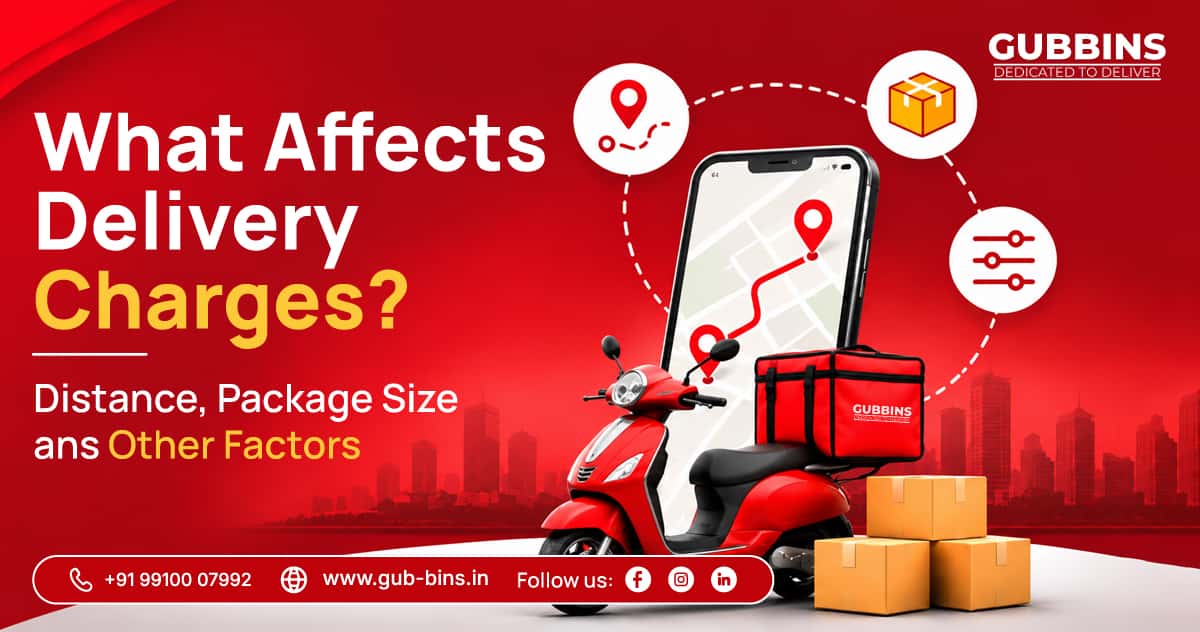
Your delivery charge isn’t a price. It’s a calculation, and most senders never see the math behind it.
Distance is only one input. Package size, weight, speed, and extra fees all change the final number. Understanding delivery charges and pricing factors is the difference between predicting a quote and being surprised by one.
Below, we break down what goes into the calculation and how to keep each part working in your favour, whether you ship daily or send a parcel once a year.
Weight vs. Size: How Volumetric Weight Inflates Your Bill
Couriers don’t only charge for how heavy your parcel is. They charge for the space it takes up in the vehicle.
That gives every parcel two weights:
- Actual weight: what the parcel weighs on a scale.
- Volumetric weight: a calculated weight based on its size, using length × width × height (in cm) ÷ a divisor.
The provider bills whichever is higher. That’s your chargeable weight.
For most domestic couriers in India, the divisor is 5000. So a box measuring 40 × 30 × 20 cm has a volumetric weight of 24,000 ÷ 5,000 = 4.8 kg, however little is inside it.
A worked example (illustrative)
|
Item |
Actual weight |
Box size |
Volumetric weight |
Billed weight |
|
Scarf in an oversized box |
0.3 kg |
40 × 30 × 20 cm |
4.8 kg |
4.8 kg |
|
Set of books in a snug box |
2 kg |
25 × 15 × 10 cm |
0.75 kg |
2 kg |
The scarf weighs a fraction of the books, yet it’s billed at more than double the weight. The extra air in the box is what you pay for.
What to do about it
- Measure the box after packing, including padding.
- Use the smallest box that protects the item.
- Calculate volumetric weight before you book, then compare it with the actual weight.
Check the divisor first. It isn’t universal. Some providers use 4000 for certain services, and contracts can set their own. Confirm the figure on your provider’s rate card before you calculate.
Speed and Handling: Why Urgent, Fragile, and Bulky Cost More
Distance and size set the base price. Speed and handling decide what gets added on top.
Speed is a premium
A standard parcel shares a route with others. An urgent one doesn’t. Same-day and express services assign a rider quickly and often run a direct trip, so capacity is reserved for you. You’re paying for priority, not just kilometres. That’s also why a grocery delivery in 1 hour is priced differently from a next-day parcel.
What you send changes the price
Not every item travels the same way:
- Fragile items need careful carrying and sometimes extra packaging.
- Perishables, like cakes and flowers, need quick, steady trips.
- High-value items may need insurance or proof of delivery.
- Bulky items need more room, and sometimes more hands.
Vehicle often sets the base rate
In on-demand delivery, a bike, a three-wheeler, and a mini truck each have their own base price. A parcel that won’t fit on a bike moves up a tier, however short the trip.
Many on-demand delivery services work as a pickup and drop service. A rider collects from one address and delivers to another, and the price reflects distance, vehicle, and speed.
How to keep this in check
- Sellers and SMEs: Offer standard delivery by default, and charge a clear premium for urgent orders.
- Shoppers and occasional senders: Book earlier. Urgent is a convenience you pay for.
- Everyone: Tell the provider exactly what’s inside, so you get the right vehicle the first time.
Hidden Charges: What Else Shows Up on the Final Bill
The base rate is rarely the whole story. Several delivery cost factors only appear at checkout, or on the invoice afterwards, and they can push your parcel delivery cost well above the first quote.
Where and when you send
- Remote pin codes: Hard-to-reach areas can carry extra charges.
- Peak hours and festival days: Demand rises, and so can prices. Some providers use demand-based pricing.
- Weather and night deliveries: Difficult conditions and odd hours can add a premium.
Location and timing matter across Delhi NCR too. Compare the best delivery partner in Delhi for your route, or a delivery service in Noida if your parcel crosses the border. If you need same day delivery in Delhi NCR, book early. Last-minute slots are where premiums tend to stack up.
Add-ons that appear on the bill
- Fuel surcharge
- Cash-on-delivery (COD) fee
- Packaging charges
- Waiting time
- Insurance
- Return or RTO (return to origin) charges
- Redelivery attempts
- GST
Returns and failed attempts catch sellers out most. A parcel that can’t be delivered can cost you the trip out, the trip back, and a second attempt.
One habit that fixes most of this
Always ask for the all-in price, not just the base rate. Two questions do the job:
- “What is the total, including every fee and tax, if everything goes as planned?”
- “What extra will I pay if the delivery fails or is returned?”
A clear provider answers both easily. A vague answer is a warning sign.
How to Keep Delivery Charges Under Control
You can’t change the distance. You can change almost everything else. Once you know the main delivery cost factors, each one becomes a lever.
Sellers, SMEs, and marketplace sellers
- Right-size your packaging. A smaller box means a lower volumetric weight, and a lower bill on every order.
- Negotiate volume rates. Regular shipping gives you leverage. Ask for better rates, and ask how extras like returns and COD are priced.
- Set a clear shipping fee policy. Pick one: a free-shipping threshold, a flat rate, or pass-through pricing. Each protects your margin differently, so test which one your customers accept.
- Compare the final billed cost. The cheapest quote isn’t always the cheapest courier once returns and failed attempts are included.
Startups
Build a simple cost model before you set prices. For each order, add packaging, the average delivery fee, expected returns, and payment fees. Subtract that from your margin. If the number surprises you, better to find out now. Delivery isn’t your only early expense, either. As your team grows, HR software for startups can keep your people costs as visible as your shipping costs.
Consumers and occasional senders
- Measure and weigh accurately. Guessing is how surprise charges happen.
- Ask what’s included. Get the all-in price before you book.
- Book earlier. Peak and urgent premiums are mostly the price of last-minute planning.
If you’re comparing local delivery charges, look for a delivery service in Delhi that states its pricing clearly and answers questions before you book. Clarity at the quote stage usually means fewer surprises at the bill stage.
Quick Answers: Delivery Charges and Pricing Factors
What factors affect delivery charges?
Six factors set most delivery charges:
- Distance or delivery zone
- Actual and volumetric weight
- Package size
- Delivery speed
- Item type and handling
- Extra fees and taxes
What is volumetric weight in delivery?
Volumetric weight is a calculated weight based on a package’s size, not its actual weight. Couriers multiply length, width, and height in centimetres, then divide by a divisor, commonly 5000 in India. They bill whichever is higher: actual or volumetric weight.
Why do delivery charges vary by distance?
Longer distances need more fuel, time, and rider capacity, so prices rise. The model also matters: on-demand services usually price by kilometre band and vehicle, while traditional couriers price by zone, such as same city or metro to metro. The same distance can therefore cost differently.
Why is same-day delivery more expensive?
Same-day delivery costs more because it uses priority capacity. A rider is assigned quickly and often makes a direct trip instead of sharing a route. You pay for speed and reserved capacity, and last-minute or peak-hour bookings can add further premiums.
How can I reduce delivery charges?
Use the smallest box that protects your item, weigh and measure accurately, and book earlier to avoid urgent premiums. Sellers can also negotiate volume rates and compare the final billed cost, including returns. Always ask for the all-in price before you book.
How is the delivery charge calculated?
Providers start with a base rate set by distance or zone, then apply the higher of actual or volumetric weight. They add charges for speed, item type, and vehicle, then extras such as fuel surcharge, COD fees, and GST. The sum is your final charge.
Know the Calculation, Control the Cost
You can’t change the distance. You can change the box, the timing, and the questions you ask.
So before you book, weigh the package. Measure its length, width, and height. Then ask each provider for the all-in price, including every extra. Understanding delivery charges and pricing factors turns a surprise bill into a number you saw coming.
Ready to see yours? Get a delivery quote with Gubbins, our on demand delivery service for Delhi NCR.
Sending orders every week? Talk to us about regular volume, or save the delivery-cost checklist for your next booking.
Gubbins India • 2026-11-10
It’s 4 p.m. The cake is due at 6. The rider hasn’t shown up, and your customer is calling for the second time.
If you run a bakery, flower shop, or restaurant, you know this moment. Your reputation is sitting on the counter, waiting for someone else to move it. If you’re sending a gift or a forgotten document across town, it feels the same: one chance, no backup.
Here’s what most people miss. Urgent deliveries rarely fail because the courier was too slow. urgent delivery service fails because something went unchecked. The wrong vehicle. A half-written address. A recipient nobody could reach.
None of that takes long to catch.
Below is a two-minute check to run before you book. It covers most of what goes wrong, and it works whether you send fifty orders a week or one.
What “Urgent” Really Means (and Where It Breaks)
An urgent delivery isn’t one action. It’s five, and each can fail on its own:
- Order ready: packed, sealed, and waiting.
- Rider assigned: someone has accepted the job.
- Pickup: the rider reaches you and collects it.
- Transit: the trip itself.
- Handover: the right person receives it.
Most people watch only transit, but that’s rarely where things break. Delays hide in the joins between steps. The rider waits ten minutes because the order isn’t packed. Another circles a building because the pickup contact didn’t answer. Time disappears between steps, not during them.
That’s why “delivered in 30 minutes” needs a follow-up question. It can mean:
- 30 minutes until a rider is assigned
- 30 minutes from pickup to drop
- 30 minutes door to door, start to finish
These are very different promises. Ask which one you’re getting, and what happens if it’s missed.
The same five steps apply to paperwork. If you’re sending documents instead of a cake, our guide to the Best Way to Send Documents Urgently shows what to check at each one.
Check What You’re Sending and How It Will Be Carried
“Any rider can carry anything” is the most expensive myth in urgent delivery. Different items fail in different ways, so ask before you book.
|
Item |
Main risk |
What to ask |
|
Cakes |
Tilting, heat, vibration |
Will it travel flat? Is the vehicle suited to its size? |
|
Flowers |
Crushing, wilting |
Will it stay upright and out of direct sun? |
|
Hot food |
Spillage, cooling |
Is there insulated carrying? How long is the trip? |
|
Documents and medicines |
Loss, rough handling |
Is there proof of delivery? Will it be handled with care? |
Four questions cover most of it:
- What vehicle will carry it? Size and weight decide this.
- How will it be secured? Loose in a bag is not secured.
- Does it need temperature care? Heat ruins cream and chocolate. Cold wilts petals.
- Has the rider handled this before? Experience with similar items matters.
Here’s why it matters. A tiered cake on a bike takes every bump and sharp turn. It can lean, slide, or crack before it reaches the main road. The same cake, laid flat in a car, arrives intact. Same distance, same speed, different result.
Weight matters too. Gubbins riders deliver orders up to 17 kg, so a bulk restaurant order or a large gift hamper doesn’t need to be split. Always confirm the limit before you book, whichever service you use.
Sending a present instead? Our guide on how to Send Last-Minute Gifts covers what to check when time is tight.
Do Your 5-Minute Prep Before You Book
Here’s an uncomfortable truth. Many “slow” urgent deliveries are slow before the rider even moves.
The cake isn’t boxed yet. The address says “near the main market.” The recipient’s phone is off. The rider arrives and waits, and every minute of waiting comes out of your deadline.
The good news is that this is the part you control. Five minutes of prep can save thirty.
Run this checklist before you tap “book”:
- Order ready and packed. Sealed, labelled, and sitting at the pickup point. If it’s still being finished, book when it’s nearly done, not before.
- Full address with a landmark. Include the building name, floor, gate or tower number, and one landmark. “Flat 4B, Tower 2, opposite the petrol pump” beats a pin drop alone.
- Both phone numbers were confirmed. Check the sender’s and the recipient’s numbers, and make sure both people will pick up. A wrong digit costs more time than traffic.
- Pickup contact named. Tell the rider exactly who to ask for and where to go. In a busy shop or a large building, “ask for Rahul at the counter” saves minutes.
For gifts, add one more line: tell the recipient a delivery is coming, unless it’s a surprise. If it is, name a backup person who can accept it.
None of this makes the courier’s job easier for its own sake. It means that when the rider arrives, the only thing left to do is the delivery.
That’s the real shift. Instead of hoping the courier is fast, you remove the reasons for delay before they start.
Plan the Handover, Not Just the Address
A delivery isn’t finished when the rider arrives. It’s finished when the right person receives it in good condition.
That last step is where many good orders stall. The rider reaches the right address and still can’t complete the job.
Four handover problems come up again and again:
- Gated societies. The guard won’t let the rider in without a call to the resident. If the resident doesn’t answer, the order waits at the gate.
- Reception desks. Offices often accept parcels but won’t release a cake or flowers to “whoever is free.” Perishables can sit there for an hour.
- Surprise gifts. The person who would accept the order is the one you’re hiding it from. Calling ahead ruins the surprise, and not calling risks a refused door.
- No one home. A perfect order sitting at a locked door is still a failed delivery.
A simple plan prevents most of this. Settle three things before you book:
- Who accepts it. Name one person, and share their number. If it’s an office, give the person’s name and floor, not just the company.
- A backup contact. Choose someone else who can receive it: a family member, a neighbour, a colleague, or the front desk. Share their number too.
- What the rider does if no one answers. Decide this in advance. Should the rider wait ten minutes, call you, or leave it with the guard? For cakes, flowers, and hot food, leaving it unattended is rarely the right call.
For shop owners, add one line to your order form: “Alternate contact for delivery.” It takes a few seconds, and it saves the call you dread.
For surprise gifts, give the rider a cover line, such as “a delivery for [name] from work,” so the recipient isn’t alarmed and the surprise holds.
Plan the last 30 seconds as carefully as the first 30 minutes.
Ask What Happens If Something Goes Wrong
Most providers will tell you how fast they are. Few are asked what happens when they aren’t.
That’s the question worth asking. A provider’s answers show how they behave under pressure, and that tells you more about reliability than a price tag or a speed claim.
Ask these four things before you book:
- Live tracking. Can you see where the rider is, or do you have to wait for updates?
- A contact you can actually call. Is there a real person or number for this order, or only a chatbot?
- Delay and damage policy. What happens if the order is late or arrives damaged, and who decides?
- A backup rider. If the rider cancels or breaks down, is someone else assigned, and how fast?
Vague answers are an answer. “We’ll look into it” is not a policy.
Why this matters more for shops
For a business, the delivery fee is often the smallest number in the equation. Here’s a worked example. It’s illustrative, so swap in your own figures.
Say you can book a rider for ₹80 or a more reliable one for ₹140. The difference is ₹60. Now suppose the cheaper delivery damages a cake:
- Remaking it (ingredients and labour): ₹800
- Booking a second delivery: ₹140
- An apology credit for the customer: ₹300
That’s ₹1,240 in direct costs, more than 20 times the ₹60 you saved. It doesn’t include the customer who may never order again.
The cheapest fee only looks cheap if nothing goes wrong. Ask what happens when it does.
Urgent Delivery Quick Answers
What should I check before booking an urgent delivery?
Check five things before you book:
- What’s being carried, and how fragile it is
- Whether the vehicle suits its size and weight
- The recipient’s number, plus a backup contact
- Who accepts the order, and where
- A support contact you can actually call
How do I book an urgent delivery?
Choose a delivery service, enter the pickup and drop addresses, and add both phone numbers. Select the vehicle that suits your item, confirm the price, and book. Have the order packed and ready before the rider arrives, so pickup takes minutes, not half an hour.
How fast is an urgent delivery?
It depends on distance, traffic, and how ready the order is at pickup. Always ask what the quoted time covers: rider assignment, pickup to drop, or door to door. A 30-minute promise can mean three different things. Peak hours and festival days add time.
How can I send a cake or flowers safely by courier?
Choose a vehicle suited to the item’s size, keep cakes flat and flowers upright, and use sturdy, secure packaging. Tell the rider what’s inside and mention heat or fragility. For tiered cakes, a car is safer than a bike. Confirm the weight limit before booking.
What if my urgent delivery is late or damaged?
Contact the provider immediately through their support number, and share the order ID and, for damage, photos. Ask about their delay and damage policy and whether a replacement delivery is possible. Better still, ask about the policy before you book.
Conclusion
Urgent deliveries don’t fail because the world is unpredictable. They fail because small things go unchecked. What’s being carried and how. Who receives it and how they’ll be reached. Who to call if it goes wrong.
You can’t control traffic. You can control the minutes before you book.
Ready to book? Book an urgent delivery - our on demand delivery service is built for moments like this. Prefer to plan ahead? Save the checklist, or talk to us first.
Urgency isn’t about moving faster. It’s about leaving less to chance.
Gubbins India • 2026-11-04
It’s almost seven in the evening, and you’ve just remembered the gift. Your sister’s birthday was today, the box is still sitting on your table, and she’s expecting it before dinner. Or maybe it’s a file your client needs first thing tomorrow. Or a handful of orders you packed this afternoon, waiting by the door with nobody to take them.
So you open your phone and search for a delivery service. A long list of names comes up, and every single one says fast, safe, reliable. You think, okay, but which one?
Honestly, most of us tap the first result and hope for the best. Sometimes it goes fine. Sometimes you spend the whole next day asking where your parcel is. A few minutes of thinking before you book can save you from that, so here we'd go about how to choose a delivery service.
If you’re short on time: Work out what you’re sending and how soon it has to get there. Then look for someone who knows your area, takes care of their riders, makes booking easy, and keeps you in the loop. That counts for a lot more than who’s cheapest.
Start With The Parcel, Not The Provider
We know, it sounds too obvious. But we skip this step all the time. A sealed envelope isn’t the same as a wrapped gift. A bag of groceries isn’t the same as a box of products going to a customer. Some things are delicate, some can’t get wet, and some just can’t be late.
So before you compare anyone, ask yourself a few easy questions. Is it fragile? Is it important? Is this a one-time thing, or will you be sending parcels often? Once you know, you’ll ask better questions, and you’ll notice quickly which providers actually listen.
Be Honest About Your Deadline
Speed costs money, and plenty of us pay for it when we don’t need to. If the gift can reach her/him tomorrow, you don’t need a rush. If a colleague is waiting on a document this afternoon, you do.
So think about how urgent it really is. If it’s urgent, look for an on-demand delivery service that can send someone when you book. If you have some free time, take a moment to unwind and explore a few options. Either way, go with the provider who tells you straight what they can and can’t do. The one who says yes to everything is usually the one who lets you down.
Check out - If you want to know the Best way to send parcels Urgently in Delhi NCR.
Find Someone Who Knows Your Streets
If you’ve ever tried explaining an address in Delhi NCR over the phone, you know how it goes. “Go past the sweet shop, take the second lane, and it’s the green gate.” A map only helps so much.
That’s why a local delivery service often does better than a big name that treats your city like any other. People who work in your area every day know which roads jam up in the evening and how addresses really work. Check that they cover the places you send to, and that they can handle the pickup as well as the drop.
Ask Who’s Actually Carrying Your Parcel
Hardly anyone asks this, and I think it matters more than almost anything else. There’s a real person behind every delivery, and the way a company treats that person usually shows in how your parcel gets handled.
Some services depend on freelancers, so you might get a different face every time. Others have riders who are part of the company. When riders are on the payroll, they know the service they represent, they answer to someone, and they tend to care how things turn out. It’s a perfectly fair question to ask any parcel delivery service: who are your riders, and how do they work with you?
Booking Shouldn’t Feel Like Homework
If it takes several calls just to confirm a pickup, take that as a warning. The best delivery partner makes the first step easy. You should be able to book, say where the parcel’s going, and reach someone quickly if your plans change.
App or website, it doesn’t matter much. What matters is that you feel in charge, and you’re not left wondering whether anyone even saw your request.
Notice How They Talk to You
You’re handing over something that matters and hoping it arrives safely. That’s trust, so how a company communicates counts for nearly as much as the ride itself.
Pay attention before you even book. Do they reply clearly? Do they sound like they’re listening, or reading from a script? If it’s hard to get a straight answer as a new customer, imagine trying to reach them when something goes wrong halfway through a delivery.
The Cheapest Isn’t Always The Cheapest
A low price is hard to ignore, I get it. But a parcel that turns up late, damaged, or not at all costs you far more than the few rupees you saved. There’s the stress, the replacement, and the customer who stops trusting you.
So instead of asking what’s cheapest, ask which option lets you relax. Is the price explained clearly? Any surprises at the end? Honest pricing usually comes from an honest provider.
Ask People Who’ve Been There
Reviews and word of mouth tell you things a website never will. Read them for patterns, not for one angry comment. Do people mention on time pickups and careful handling? And when something went wrong, what did the company do about it? A team that fixes its mistakes well is often better than one that swears it never makes any.
Even better, ask someone you know. If a friend or colleague has sent something like yours, a quick message to them is worth more than a pile of search results.
Find Out What Happens When Things Go Wrong
Even the best services have an off day. A rider gets stuck in traffic, the person receiving the parcel isn’t home, or an address turns out to be harder to find than anyone expected. It happens. What matters is what comes next.
Before you book, find out how the provider handles problems. Is there a real person you can call or message? Will they tell you early, or only after you’ve started worrying? A good provider treats a delay as something to sort out with you, not something to hide. You don’t need a perfect record. You need a team that picks up the phone and owns the problem.
Get Your Parcel Ready Before The Rider Arrives
A little preparation goes a long way, and it only takes a few minutes. Pack the item snugly so it doesn’t shift around. If it’s fragile, say so when you book and mark the outside too. Write the drop address clearly, add a landmark if the lane is tricky, and keep your phone nearby so the rider can reach you. If someone else is receiving it, give them a heads up that it’s coming.
Most delivery trouble isn’t dramatic. It’s a missing landmark, or a phone left on silent. Small things, and easy to avoid.
It Depends On Who You Are
The right choice changes with your situation.
If you’re a busy professional, you probably want to book from your desk and get on with your day. Easy booking and dependable pickups come first.
If you run a small business, maybe a home bakery or a little online shop, you need someone you can count on week after week. Your customers are waiting, and you want to hear early if something changes.
And if you’re just sending a gift or some papers to someone you care about, you want it handled gently, and you want the whole thing to be simple. That’s really all.
Figure out which of these sounds most like you, and the choice gets a lot easier.
How to Choose the Right Delivery Service
If you're still wondering how to choose a delivery service, don't overthink it. Start with what you need, then find a provider who can make the whole process easier. A good delivery service should do more than simply pick up a order and drop it off. It should give you confidence that your package is in safe hands and will reach the right person on time.
Look for a few things before making your decision. Check whether the provider covers your pickup and delivery locations, offers the delivery speed you need, and has clear pricing. It's also worth finding out who handles your parcel, how easy it is to book a pickup, and whether you can reach someone if there's a delay.
If you're sending parcels regularly, choose a reliable delivery service that understands your routine rather than one that works for you only once in a while. For occasional deliveries, a simple booking process and flexible pickup options can make all the difference. And if most of your deliveries are within your city, a local delivery service with good knowledge of the area is often a practical choice.
For example, if you're based in Delhi NCR and need someone to handle urgent documents, personal packages, or business orders, Gubbins offers on-demand pickup and delivery with its own team of riders. It's one option worth considering when you want a straightforward delivery experience without too much back-and-forth.
At the end of the day, the right delivery provider is the one that fits your needs, respects your time, and gives you one less thing to worry about.
Where Gubbins Comes In
We started Gubbins for the moments at the top of this post: the file that can’t be late, the gift that has to get there in time, the order a customer is waiting for. We’re an on-demand pickup and delivery service across Delhi NCR, and our riders are on our payroll, so the person handling your parcel is part of our team.
You can also book a pickup and drop from anywhere in India for delivery to a location in Delhi, which cuts out a lot of the back-and-forth.
Ready When You Are
Choosing a reliable delivery service doesn’t have to be stressful. Know what you’re sending, be honest about timing, and go with someone local, clear, and consistent.
When you’re ready, take a look at Gubbins’ delivery options and book the one that suits you. Visit www.gub-bins.in or download the Gubbins app to get started.
Your trusted grocery delivery app and more, with fast and reliable deliveries at your fingertips.


Seamless onboarding, easy ride management, and earnings at your fingertips.